Thursday, June 12, 2014

UPDATE ON OIL

We understand there's much to do about oil owing to the recent Iraq situation, the Ukraine and other troubled oil-producing areas around the globe, not to mention the downward pressure put on the producers of the black stuff by the climate-change crowd.

With oil's recent surge above $106 a barrel, its highest level in nine months, concern is starting to mount. Anyone short oil in recent weeks is beginning to feel some pain just as the longs might do later if a calmer period develops in some of these areas.

Iraq Total Oil Production (1980 - 2013)

Higher prices could put oil  producers in a more enviable position to search for more oil. It's also something the Russians firmly welcome given the sanctions. Not so with the EU. To be sure, others will say the recent explosion of the shale oil business will help soften the blow somewhat.

That's a real possibility but it's just as possible that the U.S. will  figure out some way to squander what resources it currently has in the shale beds. For such a much-hated commodity that federal and state bureaucrats and politicians love to feast on for a source of their fanciful spending ventures it's one of the great human hypocrisies. 

The point here is oil will remain a volatile commodity for years to come. And we're still buyers for the long term on any pullbacks.




EXPECT THE UNEXPECTED

http://blogs-images.forbes.com/kenrapoza/files/2013/01/emerging-markets-sign.jpg

If you bothered to read our recent post about Mexico, you'll recall we stated not a single economist predicted the recent rate cut. 

Now there is no issue here with timeliness or one upping anyone just further collaboration. We've been talking about EMs and how at the beginning of the year they were cited by the cognoscenti as the place not to be.

That this has been a difficult and surprising year, one few saw coming, should not surprise. And that's the point. After the incredible debacle at the Bay of Pigs, President Kennedy was quoted as saying in a regretful, self-castigating tone that he knew all along not to trust the experts.

After the great stock market run of last year too many expected smooth sailing ahead. That could still occur. But truth be spread, there are just as many things that could go wrong as could go correct. And most of us humanoids, though we rarely care to admit it, look only for those things that buttress our own beliefs.

Here's decent quick summary on recent EM actions.
http://www.marctomarket.com/2014/06/emerging-markets-what-has-changed_12.html 


HOT RISING CURRENCY

The late Hall of Fame baseball pitcher Leroy "Satchel" Paige advised: "Don't look back 'cause something might be gaining on you."

Though some might say this is panicky talk, if you're the U.S. government you might want to give old Satchel's advice a closer look.

Azerbaijan's a country most Americans would likely have a difficult time finding on the map. A former member of the Soviet Union, the oil rich country is an important wedge between Russia and Iran. Baku is the capitol city.

The country recently announced its sovereign wealth fund plans to invest $1.8 billion in the Chinese renmimbi this year. According to the FT, it is the "largest investment in the Chinese currency to be made public --and a further indication of its rapid move towards reserve currency status."

The CEO of the $37 billion State Oil Fund reported to the FT the fund was seeking permission to access the renminbi assets and start investing in the currency before the end of the year. As the renminbi grows in international important it was the seventh most used currency for international payment in April, an amount that doubled in a littler over one year.

The Azerbaijan fund is not alone in buying renmimbi. Some reports suggest central banks and other wealth funds are starting to buy the Chinese currency but only a few have publicly confirmed these purchases. The Reserve Bank of Australia, Chile and Nigeria's central bank hold renmimbi in their reserves along with Japan and Malaysia.

As noted those are the ones publicly known. The recent big energy deal between Russia and China and the fact there's talk about the BRICs finding an alternative currency to settle accounts if access to the dollar changes should also trouble U.S. officials.

In foreign policy the US is a victim of the damned-if-you-do-and-damned-if-you-don't concept. But that hardly excuses the fact that it is also a country that continues to suffer from pitiful leadership hardly unique to the current feeble, pathetic administration. It breeches generations.

It's not our intent to name names because if we did one of the names that would have to be tossed into the ring is the name of the people themselves. They have and continue to tolerate it. They do so, apparently bereft, that it's their future economic welfare and freedom at stake here.


Tuesday, June 10, 2014

AROUND THE WEB


Not Your Father's Ponzi Scheme
http://www.acting-man.com

Deaf Ears
http://www.minyanville.com/business-news/politics-and-regulation/articles/Moscow-and-Kiev-A-Dialogue-Of/6/10/2014/id/55250

Dropping The Bubble
http://www.testosteronepit.com/home/2014/6/10/feds-bullard-the-bubble-was-developing-under-our-noses.html

Fed Needs To Start Hiking Rates
http://www.marketwatch.com/story/fed-needs-to-start-raising-rates-top-forecaster-says-2014-06-10

Another Central Bank Adds Liquidity
http://www.reuters.com/article/2014/06/10/peru-centralbank-idUSL2N0OR2KL20140610

Buy High, Sell Low
http://www.nytimes.com/2014/06/07/your-money/fear-of-equities-drives-more-investors-to-cash.html?_r=0

BP Gets First Drone
http://www.latimes.com/business/aerospace/la-fi-faa-bp-drone-20140609-story.html

CRAZINESS ABOUNDS

 
There's an old saying, look and you'll find what you're looking for. Perhaps nowhere is that more true than in medicine. But then again maybe climate change is another sure-fire area.

Perhaps an exception to the rule today is in the financial markets. If you look for craziness you won't have to look very far or hard. There's more than enough to go around.

"Some Spanish government bond yields dipped below U.S. Treasury bonds, adding another twist to the year of surprises for the world's bond markets," the WSJ recently reported. Now we think technically the U.S. isn't in such great shape. Probably a more apropos description would be something like: An undeclared bankrupt country looking for a proper time and place to come out of the closet.

The U.S. for now still enjoys the international currency of trade, an advantage no other country has. But don't blink too long or you might miss it if there are not some serious and severe structural changes that have a lot more to do with bankrupt leadership than income inequalities or the trumped up caterwauling about the wealthy.

Now Spain, that's another can of beans. Unemployment there, generously noted, is between 20-25 percent, one section of the country wants to secede (Come to think of it, the same thing 
is going in the US!), and much more. But we'll spare you the rest and just direct you to this site.

The point is Spanish 10-year bonds are now yielding less than U.S.10-year bonds and no one apparently thinks that crazy.
http://globaleconomicanalysis.blogspot.com/


POLICY ERRORS

Looking over the current landscape one sees headlines like this from the Financial Times: "US stocks soar as US's 'fear gauge' hits semi-year lows."

Stock prices are up, inflation, so they tell us, down and volatility AWOL. When things get too far over the line, as they sometimes do, there's usually a correction or regression to the mean of sorts. The absence of fear, at least in markets, is almost always joined at the hip with the absence of common sense.    

We recall in our many travels strolling into a noted chest surgeon's office some years ago to interview him and noticing a sign on the wall behind his desk: "There is nothing more uncertain or dangerous than a state of absolute certainty."

That pretty much sums up investor attitude about this market. The Fed apparently has convinced investors they won't be jacking up interest rates until sometime in 2015. And even then they'll raise them orderly.

Now what we don't hear--and this is our take on it--is any contingency for policy error. Most seem to take for granted the bureaucrats at the Fed will get it just right. The truth is they may already be behind the curve. Such things are usually only discerned in retrospect.

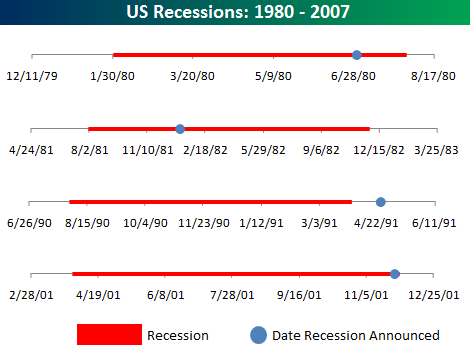
The Fed in the past has missed numerous recessions either going in or coming out. Truth be told, they usually miss them on both ends. In fact, the old joke about economists is they've correctly called nine of the last two recessions.

Note also that central bank bureaucrats every time they cut rates they claim they averted disaster. What they're really doing is causing it.

Now we don't want to trouble you with too much history especially since other than revisionists not too many today are interested.  Harry Truman, the U.S.'s 33rd president, once noted, "The only thing new today is the history you failed to learn yesterday."

So just to bolster your confidence in government and bureaucrats, we'll close with three things here in America they run well: Amtrak, the Post Office and the VA Medical Centers.

What the chart below shows is the Fed missed on three of these four recessions, odds not much better than one would get in Vegas.


Monday, June 9, 2014

WARNING SIGNS?

Earnings no longer in tandem with stock prices in the EU.

This article by Wolf Richter appeared 6-8-14 on David Stockman's Contra Corner.


Here's a couple of paragraphs from the post.

For years, EPS of the Stoxx companies and the index itself have been rising and falling roughly in parallel. The chart, based on data from FactSet, picks up in 2005. The index was tracking earnings perfectly on the way up. On the way down during the financial crisis, EPS lagged, given that companies report quarterly and the index crashed by the second. Then EPS recovered – OK, in Europe, financial engineering is just as normal as in the US – while the index lagged behind as the debt crisis was raging. But when the index took off, an ugly thing happened:

Since July 2011, earnings have been falling!
And that, despite quarter after quarter of Wall-Street forecasts of dizzying earnings growth for future quarters that then get whittled down to nothing!

As of May 30, according to data provided by FactSet, the Stoxx 600 had EPS of 23.67. That’s down 0.7% from a year ago, and down 11.2% from July 2011. These miraculous European companies that make up this gravity-defying index and that have been trumpeted by Wall Street with such conviction are making less now than they did three years ago during the depth of the Eurozone debt crisis!


GOBBLEDY MEETS GOOK


You got to give it to central bankers and their loads of economists. They like to take a language and screw it up as badly as they can, almost as badly as governments around the globe like to screw taxpayers.

We'd include a host of others who enjoy torturing the language, but space doesn't permit. Yet most of you sociologists, psychologists and business school grads know whom we're talking about. So for now we'll start with this cute phrase that came out of a recent Financial Times article about the ECB and their new found love for financial charity.

One for the money, two for the show, three to get ready and here we go: "monetary transmission mechanism." In case you haven't guessed it, it's broken. Wow! Sounds like a Bad Day At Blackrock and we're not talking about the investment funds.

So what is the monetary transmission mechanism that's so busted? It's banks refusal to lend money or make loans irrespective of how low central bankers lower the interest rates it charges bankers. Now that brings up an interesting point. You first roll out the regulators to financially pistol whip the banks for doing all the things they should not have done in the first place and now you want them to make loans and take risk just because money is cheap.

In the past when banks were given the prospect of cheap money, they did what any sane banker would do, they bought government bonds to make guaranteed money on the spread. After all, lending to families and small businesses can be a risky business especially when you relax the the lending standards like the U.S. government did with its an affordable home for everyone program that led to the subprime explosion.

But that's a topic for another time, one that will never show up in the lives of the bureaucrats and politicos responsible. Meanwhile, we'll just entertain ourselves with some redundancies like feeling tones and aggregate demand. 

And please don't get us started on economic redundancy, a term you and I know we most likely wouldn't capisce even if it were written on the stall door in a public restroom as diversification.

Sunday, June 8, 2014

DANGEROUS BUREAUCRATS


Former French Finance Minister and now Managing Director of the International Monetary Fund, Christine Lagarde, admits she got it wrong.

In a recent interview with the BBC Legarde, a bureaucrat's bureaucrat, admitted, sort of, that those geniuses at the IMF underestimated the UK's austerity program and it's future impact on Britain's economy, according to Bloomberg.


A year after the IMF’s chief economist, Oliver Blanchard, said U.K. budget cutting risked “playing with fire,” the Washington-based lender said in April the U.K. economy will grow 2.9 percent this year, the fastest pace among the Group of Seven nations.
Legarde, politician that she is, skirted the issue when asked if she had apologized to the UK's Chancellor of the Exchequer George Osborne, replying: " Do I have to go on my knees?"  

Just remember the IMF is one big bureaucratic morass that likes to go around telling others what they should and shouldn't do. That meets the definition of a Brussels or a Washington bureaucrat in our lexicon. It also qualifies as being quite dangerous.


A DESERVING LOOK


One hates to keep beating on economists but they're such a deserving bunch.

Mexico's Central Bank, in a surprise move Friday, cut interest rates 50 basis points to 3.0 percent, citing economic weakness. Recall that Mexico was on the list of many who picked the U.S.'s southern neighbor to do well in 2014. Such has yet to materialize.

But two news organizations, Bloomberg and Reuters, reported that--you guessed it--not a single economist, zero, saw it coming. The cut sent Mexico's benchmark interest rate lower after Latin America's second largest economy behind Brazil barely grew in Q1.

This wasn't the first time the MCB surprised with an interest rate change. It happened a couple times before, all the more reason some might say for economists to be less flatfooted.

Some are suggesting the U.S.'s frigid winter and higher Mexican taxes contributed to the slow growth. Earlier the government ramped up taxes on snacks and surgery drinks in an anti-obesity move. Maybe there's a lesson here for ex-New York mayor Bloomberg and the new guy, Blasio.

The MCB also noted further rate cuts were not expected given that U.S. rates will most likely soon rise. That sounds more like wishful thinking on the administration's part given Mexico's heavy dependence on exports to the U.S.

Instead of waiting on the world to change as the words in a recent popular song go, it looks more like the world is waiting on U.S. interest rates to go up so they can export their way to recovery. Much of Mexico's  economy is based on the two Bs--buying and building. And so far both have been lackluster.

Mexican bond yields tumbled while equities hit their highest level in nearly six months as the news circulated through the market. The peso also fell briefly. In January annual inflation floated above four percent, the MCB's benchmark but recently has been falling. One of the central bank's concerns, according to Reuters, is declining domestic demand.

Mexico's situation, in some ways, is the opposite of the EU, slow growth with a inflation rate that is still too high. Meanwhile, the Mexican government in May reduced its growth forecast to between 2.3 percent and 3.3 percent after the U. S. economy faltered in Q1. And some expect another downgrade to the economic growth forecast sooner rather than later.

The U.S. is Mexico's biggest trading partner. Consumer confidence in Mexico in January hit its lowest level in four years. According to one report, Mexican President Pena Nieto's approval ratings fell to 49% from 54% since he took office, lower than his two predecessors at this stage of their administrations.

The move may make the Fed's next Open Market Committee June 16-17 meeting all the more important since it may signal an earlier than expected rise in the first hike in rates. The Fed's federal funds target has been stuck at the 0-0.25 level since late 2008.