Sunday, September 21, 2014

GOVERNMENT STUPITY RIDES HIGH

The government nonsense never ends.

The story featured here is not the first case. Just a few weeks ago 11 people in Indiana were jailed for a similar offense: growing or harvesting or having ginseng in their possession out of season.

Aside from the bureaucratic stupidity here, one of the first things that comes to mind is these overpaid official vigilantes have nothing more important to do than arrest ginseng growers.

BECKLEY, WV — Prohibitionists are boasting about arresting a number of people for harvesting ginseng plants before the government-sanctioned “ginseng season” had officially begun.

Within the last two weeks, agents from the West Virginia Division of Natural Resources (DNR) followed through with arresting at least 11 people for possessing and/or harvesting ginseng, called “sang” on the black market.

Ginseng is a wild-growing plant that is sought after by many because of its gnarly roots, which are believed to have medicinal properties. Its rarity and unusual characteristics allow it to fetch high prices per pound across the world.

In the state of West Virginia, individuals can be arrested for picking or even possessing the plant outside of a set of restrictive government parameters. Digging ginseng up before September 1 or after November 30 is considered out-of-season harvesting and strictly verboten.

For decades these people chased down pot growers and, when successful, displayed their prized seizures in huge stacks and piles on television or in the print media. One wonders now much this brilliant police work costs taxpayers every year. 

http://www.policestateusa.com/wp-content/uploads/2014/09/west-virginia-ginseng-bust.jpg 

Well, here's your answer.

The recent 190 pound bust is the result of fifteen officers of the DNR District 4 devoting up to a year in tax-based resources to investigate the illegal ginseng trade. The eleven arrests were made in McDowell, Wyoming, Fayette and Raleigh Counties, and officials say that more arrests may still be underway. Names of the arrestees were not released.

Now that plants have been seized, government agents will seek to sell the ginseng, with the proceeds going back into the agency’s coffers.

The bust also netted $30,000 in confiscated cash “collected from people illegally purchasing the root out of season and without a proper dealer’s license,” the Charleston Gazette reported. This policing-for-profit effort can be attributed to civil asset forfeiture.

Let's see now: they're spying on us day and night, they've militarized the local police and they're busting members of the sang gang. With those priorities, why the hell is anyone worried about gridlock or some slow economic growth?




TRANSPARENCY GOLDMAN SACHS STYLE

 https://encrypted-tbn0.gstatic.com/images?q=tbn:ANd9GcS4tJTje6HgDcoCUNNOL1tcFhEA6Pa7_bZXnFv5bNZ3RuTR-G7t

There's no intrigue like old intrigue. And the same goes for cronyism and long established firms.

It turns out Wall Street investment bank Goldman Sachs apparently meets both criteria.

As we've noted before you don't have to look very hard to find Goldman Sachs' tentacles spread around from central bankers to political appointees in high places. The list of current central bankers with former Goldman ties is lush and long

It's a sticky, incestuous financial web they weave. The Goldman alumni club would rival that of most Ivy League knowledge boxes. Here's a quote from today's Financial Times.

Goldman Sachs has admitted in court documents that it used an internship, training, small gifts, occasional travel and entertainment to cement a “strategic partnership” with the Libyan Investment Authority under the former Gaddafi regime.

The bank’s defence to a $1bn lawsuit filed by the LIA in London in January lifts a veil on techniques deployed by the company and other western financial institutions to win and deepen client relationships with the $66bn sovereign wealth fund – techniques that law enforcement agencies in the US are probing as to whether they tipped over into potential bribery.

We love the emphasis on "small gifts."

Goldman argues that none of its actions amounted to improper or unusual influence and that it maintained at all times “an arm’s-length banker and client relationship”, according to its defence filed at London’s High Court last week.
The LIA accused Goldman in January of entertaining former high-level LIA officials in Morocco, the “extensive expenses” of which were paid for using a Goldman credit card.

This is the way the Wall Street Journal characterized Goldman's actions in the case.

The filing marks Goldman's most-extensive public defense yet of its dealings with Libya in the late 2000s, during the brief period between the North African country's opening to western investment and the fall of Col. Moammar Gadhafi. The push by Goldman and other financial firms to pursue deals with Libya's fledgling wealth fund has drawn scrutiny by U.S. securities regulators and federal prosecutors.

The Wall Street Journal reported Thursday that the Securities and Exchange Commission is investigating an internship and other perks it allegedly offered to win LIA business. Some of those allegations, including the internship, had appeared in the LIA's lawsuit.

With all those Goldman ties to the Federal Reserve perhaps we need a new definition for the term transparency.
t. man hatter


Saturday, September 20, 2014

FOR THOSE WHO BOTHER


For those who bother to read our posts regularly--we think there are at least two now, though one is a distant cousin from all indications--you know we have written often about energy stocks.

Here a brief list of some articles: "Energy Spike Intrigue," "What The Frack Is Happening," "Don't Sleep On Energy," "Nimby Nuts," "What The Market Offers" and several more. Earlier this summer when energy ran up with crude hitting $115 a barrel we said there'd be a pull back.

In fact, we mentioned the coming pullback before it topped out. That's pretty much how markets work. Few observers ever hit exactly the pullback or turn around numbers. Nor is it necessary. Close is good enough in most cases to make serious money.

Well, though it might have some more to go, we're getting it. Wall Street bromides abound. Never try to catch a falling knife is one. Despite all the glut talk, energy is no falling knife. Smart traders put their positions on in tranches. And so should you.

Energy needs to be a permanent part of one's portfolio. As we navigate the Internet we look for stories that agree and disagree with our feelings about a stock or sector, notwithstanding all the macro-micro stuff.

Truth be told, we especially like those that differ from our opinions.

Like new highs and lows, we try try track or keep count, sort of like counting cards in blackjack. When the stories start piling up too far to one side or the other, we get interested.

But you need to do your own research and pick your own stocks. Here is a link to a recent post you might find interesting. Suffice it to say we own and very much like the prospects for some of the companies named here.

http://www.marketwatch.com/story/5-reasons-energy-stocks-will-stage-a-second-rally-in-2014-2014-09-19


Friday, September 19, 2014

AROUND THE WEB


1. SYMBOLISM MATTERS
http://www.psmag.com/navigation/health-and-behavior/symbolic-power-act-emptying-pockets-israel-curbs-generosity-90790/

2. SHALE EARTHQUAKE DEBATE
http://bakken.com/news/id/221514/oklahoma-growing-epicenter-earthquake-debate/

3. FRESH SELLING HITS GOLD
http://www.mining.com/new-low-for-gold-price-55036/

4. BUBBLES EVERYWHERE
http://finance.yahoo.com/news/bubble-bubble-ol-marc-faber-121647662.html

5. MORE TEARS AHEAD
http://www.bloomberg.com/news/2014-09-19/argentina-s-poverty-rate-may-quadruple-to-40-world-bank-says.html

6. ANTI-MUSLIM ADS
http://www.theguardian.com/world/2014/sep/19/pamela-geller-new-york-buses-subways-islam-james-foley

7. INTERNET BAN
http://www.blacklistednews.com/Putin_Seeks_Ways_to_Cut_Russia_Off_From_the_Internet/38060/0/38/38/Y/M.html

8. BALANCE OF TRADE
http://www.fee.org/the_freeman/detail/23-the-balance-of-trade-deficit-requires-government-action

ENERGY SPIKE INTRIGUE


Webster's defines paradox as "a seemingly absurd or self-contradictory statement or proposition that when investigated or explained may prove to be well founded or true."

With the global economy in a grinding half-step mode, or even worse, depending on one's vantage point, you can bet the last thing bureaucrats want is a surprise spike in energy prices.

Oil prices softened Wednesday after the the Yellen Report reached the market and official reports of a larger than expected increase in U.S. crude stocks. Just the day before brent crude rose on rumors of  OPEC cutting production going into next year of about 500,000 barrels per day.

The price of oil is critical to Saudi leaders. If the price drifts down too much there will be a lot of squirming going on there, for sure. And the call for harsher sanctions against Russia by blowhards like Financial Times columnist Martin Wolf could sink the EU economy further than it already is.

If fears about EU deflation were any thicker one might need a chainsaw to cut them. What makes all this so intriguing is practically no one is expecting a spike in energy prices. Investors are convinced central bankers know their way out of this murky, protracted bog.

And anyone who dares question or attack these bureaucrats is subject to attack from their MSM shills as was the recent case when an electronic female media head openly attacked a longtime fund manager. That should tell you just how thin skinned these media types are.

It's quite difficult to think of enough bad things to say about MSM in general. On a particular note, this was pure, low-class-media reaching-for-ratings trash. A common staple these days.

Tolerance continues to grow thinner by the week. The Good Ship MSM is, thanks to the Internet, taking on water and they know it. Like tolerance, its influence shrivels daily.

So what does all this have to do with an unexpected spike in energy prices?  Well, that's part of the intrigue of it all. We'll have to wait and see.
t. man hatter


Thursday, September 18, 2014

NEXT YEAR ON THEIR MIND


As is often the case with relatively brief front-page splashes, stories have a way of retreating into background atmosphere.

But that hardly means they go away or anything gets resolved simply because they're mostly out of sight. Argentina is a case in point.

After a protracted battle with its creditors, Argentina decided to default on some long-hanging financial obligations dating back several years, not a first for this beautiful South American country.
Nor a second either if you bother to check its economic history.

The exchange rate for Argentina's black market dollar, the 'dolar blue', has hit its highest rate in history at 15.10 dolar blue to one U.S. dollar.
The official rate, fixed by the government, has been set at 12 pesos to the U.S. dollar since the country devalued its currency in January.
To say that things usually get bad before they get worse is no exaggeration when it comes to Argentina and it's current leadership.

As one observer put it recently: "We are all looking into 2015 already."

That's when the next election is slated. The hope is a change in leadership will bring a change in fortune.


But a new administration is not the cure for what ails Argentina. It's just a teeny tiny step on the way to a recovery. Unfortunately, paying the holdouts wouldn't immediately help the country either.
"[If they pay the holdouts] they will still have pneumonia but at least the fat man sitting on their toes will get off," Loser said. 
What he means is that this isn't even close to over, especially since economists believe that another currency devaluation is on the way, given the country's economic malaise.
This is going to get worse before it gets better.
Axel Kicillof, the socialist outspoken, bellicose Economy Minister, responded as expected whenever  nyone is trying to flimflam their way out of something during a recent radio interview, blaming "a group of hedge fund holdout creditors suing the country for over $1.3 billion of sovereign debt."

Kicillof  claimed the rate was all part of a plan to speculate the country into ruin, and dismissed the size of the underground market.
"This attack on our money was all a part of the vultures' plan," said Kicillof. "The United States representative spoke of default, and that wasn't casual... The dolar blue is a small market that is illegal... It's easy for it move quickly... There are no economic reasons for the dollar to equal 15 pesos [15 dolar blue]. This is simply an attempt to generate panic. Do not be alarmed..."
 In July after the country defied a U.S. court order and tried to stiff the bondholders, it was ruled in default.

Kicillof's rantings aside, Argentina's problems are quite real and not new to a country that has a history of such goings-on.
 http://www.businessinsider.com/argentinas-black-market-dollar-hits-record-high-2014-9

THE YELLEN REPORT


Flummoxed is as flummoxed does. And the same goes for hawkish.

There use to be an old saying about one finds what one is looking for. Perhaps the two places that's most relevant is medicine and markets.

A corollary of that is what they use to teach in medicine. If you hear hoof beats approaching you from behind in the middle of the night, think horses not zebra. We say use to teach because today we're not sure what they're teaching.

It's probably too basic for today's popular meme: complex problems require complex solutions if they're going to be valid.

Here's more fallout from the Yellen Report with some good points worth reading.
http://www.marctomarket.com/

WATER SEEKS ITS OWN LEVEL

Be careful what you water down.

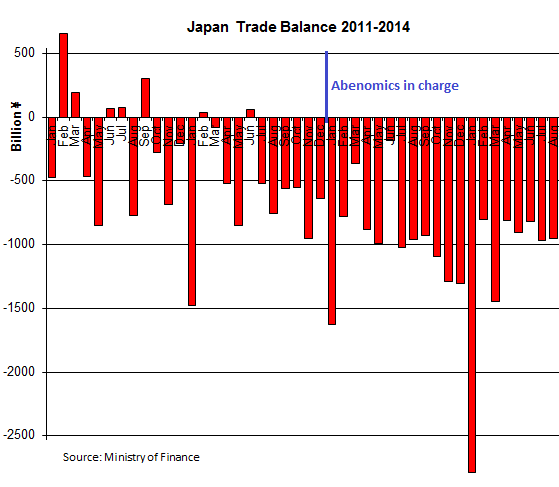
Here's an interesting chart about Japan and it's trade deficit from http://wolfstreet.com/2014/09/18/the-miraculous-impact-of-abenomics-on-trade-in-one-chart/. Could it be a lesson for what to expect  from other beggar thy neighbor policies?
http://wolfstreet.com/wp-content/uploads/2014/09/Japan-Trade-Balance_2011-2014_08.png

The one thing it hasn’t accomplished is the original goal of increasing exports and lowering imports, thus creating that all-important trade surplus that would goose GDP and make Abe and the Bank of Japan smell like a rose. The Ministry of Finance sprinkled salt on the wound today with the trade statistics for August.

For sure, many will point out Japan is not the European Union. Maybe so? But judging from what we read there's much angst afoot in MSM on both sides of the Atlantic about that possibility becoming a reality. 
t. man hatter


Wednesday, September 17, 2014

DEFLATION RISK

https://encrypted-tbn2.gstatic.com/images?q=tbn:ANd9GcSZIkO-MFj4iluJEWq5iViGKir5rSLdUUNbtCtf7DjVNTpYXUIs Ever heard of a "doom loop?


If you haven't, take a few deep breaths and relax. 

Don't start calling your therapist for some more benzodiazepines. They might give you Alzheimer's later in life. 

You'll get over it pretty much by sundown unless, that is, you live in the European Union.

According to a recent study by the those bond rating mavens, Fitch, any further move toward deflation in the good old EU could set up: "A classic debt deflation feedback loop could ensue," according to the authors. Among economists, that's better known as the "doom loop."

Quoting from a recent study, Fitch says low inflation coupled with lack of growth could "put pressure on national budgets and cripple the ability of governments to assist struggling banks, with credit ratings slashed all around."

The term "doom loop" was first coined in 2009 by the Bank of England. Simply stated, doom loop, according to Fitch, "means any government help for banks would raise their debt, making the countries themselves less stable."

It's hardly a pretty picture because if "banks deteriorate and finance ministries have to pick up the bill, they risk being downgraded themselves....(and) unemployment would rise to about 12% and stay there. That’s more than twice the rate Japan recorded when inflation went into reverse there.

Deflation, unlike inflation, punishes the borrower not lender. When a sovereign floats debt investors become the lender and the sovereign the borrower. The example Fitch uses is a "French government issued a 10-year bond in 2007, an investor expecting 2% inflation might want a 2.5% yield. Nobody likes losing money.
 
If inflation then dropped to -1%, the investor would be getting a much better deal on his bond, relative to other options. But the French government would not be happy — it would be paying a much higher real rate of interest to make that bondholder whole."

Recall during the Japanese lost decade investors there loaded up on government bonds. Weak GDP growth would usher in another problem: property, equity and other non-fixed income assets would suffer. 

Beyond that there are tax revenue consequences. When prices fall sales tax revenue declines. And as Fitch points out it wouldn't take much from here to bring this scenario about.


THE GIBBERISH CONTINUES

 https://encrypted-tbn1.gstatic.com/images?q=tbn:ANd9GcRMcCQ5rximc-tRXoy80SJxYte5FHlOMlusBXWnQuNvyPw0kqQESg

The news is out. All over town. And the winners are CT and DP.

The Yellen Report announced today at the FOMC meeting that "considerable time" and "dot plot," sounds like two fillies at Santa Anita Downs about to enter the starting gate, are the winners and will continue to play a role in Fed guidance.

 In releasing it's latest monetary policy gibberish, the boys and girls of the Fed left interest rates alone and, as expected, continued cutting back it's QE stimulus program by $10 billion. The Fed also released its latest Summary of Economic Projections, which includes the latest dot plot, which shows expectations for rates over the long run are higher than they were in June. The market is seeing these dots as a hawkish signal from the Fed.

Gibberish is really too kind of a term for these poor, pathetic bureaucrats. Given their stumbling, bumbling style, it's even questionable just how well-meaning they are. 

In the military one learns many things, but one of the most important is, stupidity will get you killed.

We already have "considerable time" and "dot plot." Now here's another one, perhaps even more feeble, to describe the labor market, "significant underutilization." 

 "On balance, labor market conditions improved somewhat further; however, the unemployment rate is little changed and a range of labor market indicators suggests that there remains significant underutilization of labor resources."

Cutting through the gibberish, the take away message is "that a highly accommodative stance of monetary policy remains appropriate." 

Plan your investments accordingly with a keen eye open for the eventual train wreck. There's surely some more air in this market puppy, but don't hesitate to periodically take some profits when they appear.

Recall this is the market you're playing, not a game of Texas Hold'em.
t. man hatter